
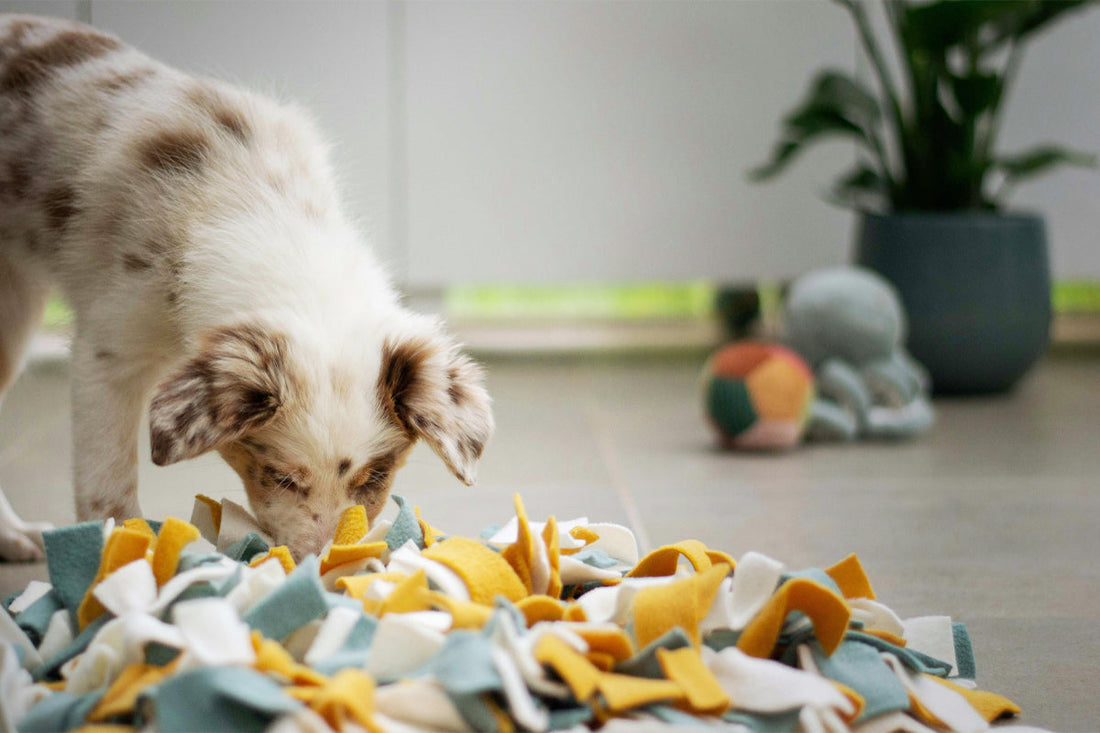
What Is a Snuffle Mat? Benefits, How It Works, and What To Buy
If you have seen a dog with their nose buried in what looks like a shaggy doormat, working their way through it with focused, methodical intensity, that is a snuffle mat in use. The level of concentration it produces in a dog that might otherwise be bouncing off the walls is one of the more reliable things enrichment has going for it.
This guide covers what a snuffle mat actually is, why the nose-work element matters so much for dogs specifically, what the real benefits are, how to introduce one, and what to look for when buying.
What Is a Snuffle Mat?
A snuffle mat is a flat base (rubber, silicone, or fabric) with strips or tufts of fleece or fabric attached in dense layers that create a surface the dog has to work their nose and paws through to find hidden food.
You scatter dry kibble, treats, or small pieces of food across the mat's surface. The dog then uses their sense of smell and physical manipulation to sniff out and extract the food from the fabric layers. The process is slow, tactile, and mentally demanding in a way that eating from a bowl simply is not.
The design mimics, in a simplified way, the foraging behavior that forms a central part of how dogs evolved to find food. Not hunting, but foraging: sniffing out food that has been scattered, hidden, or partially concealed.
Why Nose-Work Matters More Than You Might Think
Dogs have up to 300 million olfactory receptors in their nose. Humans have around 6 million. The part of a dog's brain dedicated to processing smell is, proportionally, around 40 times larger than the equivalent area in human brains.
Smell is, by a significant margin, the most information-rich sense a dog has. When a dog walks into a room, sniffs a patch of grass, or investigates a package that arrived in the mail, they are processing an enormous amount of data that is invisible to us. That processing is cognitively taxing in the best possible way. It is genuinely tiring.
This is why nose-work activities (scent games, tracking, and snuffle mats) are frequently recommended by veterinary behaviorists as the most efficient form of mental enrichment for dogs. A 15-minute scent-based activity can produce the same behavioral calm in a dog as a 45-minute physical walk.
For dogs that are under-stimulated, anxious, or prone to destructive behavior at home, nose-work is often the fastest-working intervention available.
The Benefits of Snuffle Mat Use
1. Mental fatigue and calm
The primary benefit is straightforward: a dog that has spent 15 to 20 minutes doing focused nose-work is a calmer dog. The mental effort required to systematically work through a snuffle mat (tracking scent, extracting food, moving to the next section) produces genuine tiredness that physical exercise often does not replicate for high-energy dogs.
This is particularly valuable for:
- Breeds with strong working instincts such as herding dogs, scent hounds, and terriers that need cognitive challenges beyond physical exercise
- Dogs that are physically limited by age or injury but still need mental stimulation
- High-energy dogs on rainy days when outdoor exercise is not possible
2. Slowed eating and improved digestion
Dogs that eat too quickly, bolting their food in under a minute, are at elevated risk of bloat (gastric dilatation-volvulus), regurgitation, and digestive discomfort. A snuffle mat transforms a meal that would typically take 45 seconds into one that takes 10 to 20 minutes. The slow, piece-by-piece extraction gives the digestive system time to register satiety signals properly and eliminates speed-eating entirely.
This is one of the most practical, immediately observable benefits of snuffle mat use for fast-eating dogs.
3. Anxiety reduction
Nose-work activates the parasympathetic nervous system, the "rest and digest" state that counters the "fight or flight" stress response. This is why dogs often visibly relax during and after scent-based activities. For dogs with separation anxiety, generalized anxiety, or fear-based reactivity, regular snuffle mat use as part of their daily routine can contribute to a lower baseline anxiety level over time.
It is not a substitute for behavior modification or veterinary care in severe cases, but it is a meaningful supportive tool.
4. Confidence building in nervous dogs
Finding hidden food through their own investigation produces a measurable confidence response in dogs. The repeated experience of seeking, finding, and succeeding builds self-assurance, particularly in rescue dogs or dogs that have had limited enrichment history. Snuffle mats are frequently used in shelter environments specifically for this reason.
5. An appropriate outlet for high-drive dogs
Working breeds that were selectively bred for scent tracking, retrieving, or herding have drives that do not disappear in a domestic setting. When those drives have no appropriate outlet, they come out sideways in destructive behavior, obsessive behaviors, or anxiety. A snuffle mat is not a substitute for the activities these breeds were bred for, but it is a daily outlet for instinctive behavior that is genuinely meaningful to the dog.
How To Use a Snuffle Mat
Step 1: Choose your food
Most dogs do best starting with dry kibble or small, dry treats. The pieces need to be small enough to fit between the fabric tufts but distinct enough for the dog to locate by smell. Avoid foods that are too small (they fall straight through to the base) or too oily (they clog the fabric).
As the dog becomes more experienced, you can increase difficulty by using smaller pieces, adding more aromatic treats, or making the food less uniform so the dog has to genuinely search rather than systematically working left to right.
Step 2: Prepare the mat
Scatter the food across the mat's surface, working it down into the fabric layers. For beginners, place some pieces more visibly at the top of the tufts so the first few finds come quickly and reinforce engagement. As the dog develops confidence, push more food deeper into the base layer.
Step 3: Introduce it
Place the mat on a stable surface, ideally the floor. Let the dog approach without being directed toward it. Most dogs will start sniffing immediately once they detect the food smell.
Do not guide the dog's nose to specific locations. Part of what makes snuffle mats effective is that the dog is doing their own investigation, following their own nose. Directing them undermines the independent problem-solving element that makes the activity genuinely enriching.
Step 4: Let them work
A first session might last 3 to 5 minutes for an inexperienced dog, or up to 20 minutes for an experienced one. Do not rush the session. Do not take the mat away before the dog has finished. Let them work at their own pace.
Some dogs will use their paws as well as their nose. This is fine and common.
Step 5: Supervise initially
Not because snuffle mats are dangerous, but because some dogs will try to chew or ingest the fleece fabric. Observe the first few sessions to confirm your dog is working the mat properly rather than attempting to eat the material. Once you have confirmed they are using it correctly, most dogs can be left with the mat unsupervised.
Cleaning and Maintenance
Snuffle mats need regular cleaning. Dry kibble distributes oils and crumbs into the fabric; wet treats leave residue that can become moldy.
Machine washable mats are the most practical option. Most good quality snuffle mats can go in the washing machine on a gentle cycle. Air dry flat to preserve the fabric tufts.
Hand washing: For mats that are not machine washable, soak in warm water with a small amount of mild detergent, work through the fabric tufts, rinse thoroughly, and air dry.
Frequency: after every use that involved wet or oily food, and every 3 to 4 uses for dry kibble only.
What To Look For When Buying a Snuffle Mat
Material quality: The fleece or fabric tufts should be densely attached to the base. Sparse mats are less effective and easier for determined dogs to disassemble. Check that the base is stable and does not slide on hard floors. Rubber backing or significant weight helps.
Size appropriate for your dog: A small mat for a large dog will be cleared in 2 to 3 minutes regardless of skill level. Size up for larger breeds. A 12 by 12 inch or larger mat provides enough surface area for a genuinely extended session.
Machine washable: Non-negotiable for regular use. A snuffle mat you cannot properly clean becomes a hygiene problem within a week.
Density and complexity: For beginners, choose medium density with a straightforward tuft layout. For experienced dogs or high-drive breeds, look for dense tufts, layered fabric, or multi-level construction that requires more investigation.
Shop dog snuffle mats at PetBrio
How Snuffle Mats Fit Into a Broader Enrichment Routine
A snuffle mat is one tool, not a complete enrichment program. The most effective approach for dogs combines several types of enrichment:
- Physical exercise: walks, play, running
- Nose-work: snuffle mats, scent games, tracking activities
- Feeding enrichment: lick mats, puzzle feeders, slow feeder bowls
- Social engagement: training sessions, play with people and other dogs
- Environmental variety: new routes, new smells, new contexts
Within that framework, nose-work and feeding enrichment (snuffle mats, lick mats, puzzle feeders) are the two categories that can most easily be incorporated into daily domestic life without requiring outdoor access or significant time investment.
See PetBrio's full dog enrichment range
Frequently Asked Questions
How long should a snuffle mat session last?
Most sessions naturally last 10 to 20 minutes. Do not cut them short. Let the dog finish. Sessions shorter than 5 minutes usually mean either the mat is too easy (not enough food or not pushed deep enough) or the dog has not fully engaged yet.
Can I use wet food or raw food in a snuffle mat?
You can, but it significantly complicates cleaning. If you use wet or raw food, clean the mat immediately after the session. For regular daily use, dry kibble or treats are much more practical.
My dog finished the mat in 2 minutes. Is that normal?
For a first session with a beginner-level mat, yes. Increase difficulty by pushing food deeper into the fabric, using smaller pieces, adding more pieces total, or upgrading to a denser mat with more complex layering.
Can puppies use snuffle mats?
Yes, from around 8 weeks. Use very small, puppy-appropriate pieces of food. Supervise to ensure the puppy is not chewing the fabric, and keep sessions short (5 minutes maximum for very young puppies).
How often should I use the snuffle mat?
Daily use is appropriate for most dogs. It is particularly effective as a mealtime replacement, giving the dog all or part of their daily kibble allocation through the snuffle mat rather than from a bowl.
Are snuffle mats suitable for senior dogs?
Excellent for senior dogs. Nose-work is physically low-impact but cognitively engaging, which is ideal for older dogs whose physical exercise capacity may have reduced but whose mental stimulation needs remain. It can also help maintain cognitive function in dogs showing signs of age-related cognitive decline.
What is the difference between a snuffle mat and a puzzle feeder?
Both are feeding enrichment tools, but they engage different problem-solving mechanisms. A snuffle mat is primarily olfactory: the dog finds food by smell. A puzzle feeder is primarily mechanical: the dog finds food by manipulating compartments, levers, or covers. Both are valuable. Using them on alternating days provides variety and challenges different cognitive systems.
PetBrio stocks washable snuffle mats for dogs of all sizes, sourced for durability and fabric density. Shop dog snuffle mats
About the Petbrio Team > We are passionate pet parents dedicated to cognitive enrichment. Because we know that mental stimulation is just as important as physical exercise, we personally test every puzzle feeder, lick mat, and interactive toy on Petbrio with our own pets. If it doesn't pass our rigorous standards for durability and engagement, it doesn't make it to our store.
