
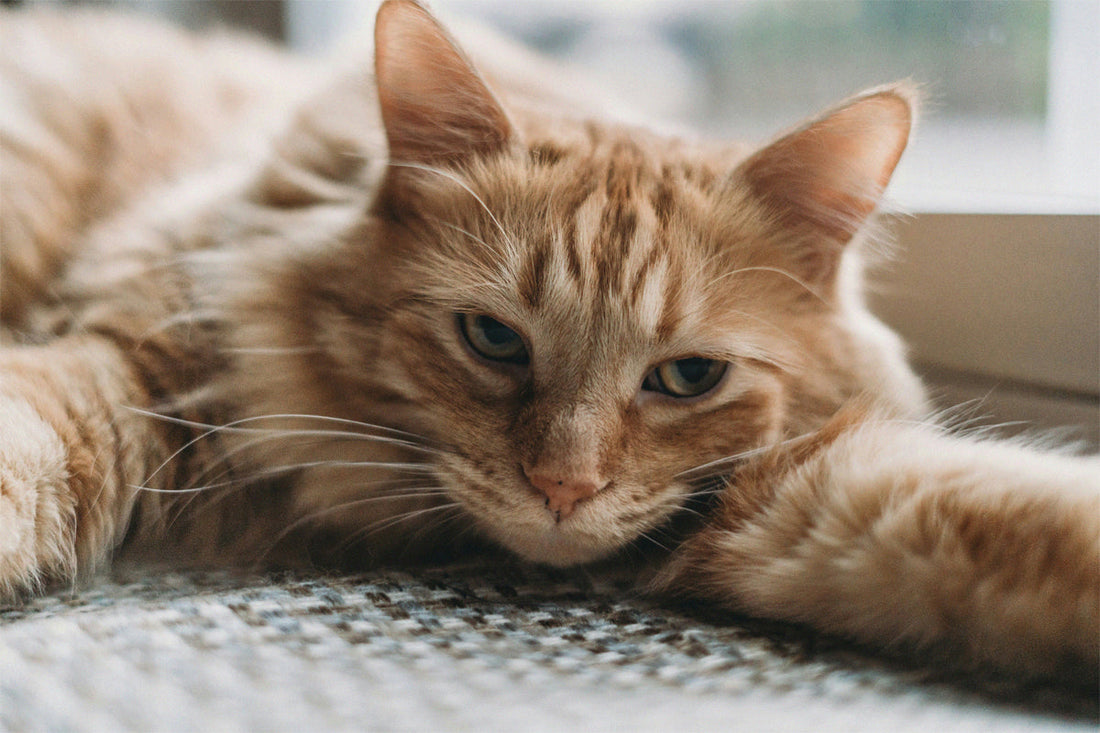
Signs Your Cat Is Bored and What To Do About It
Cats have a reputation for being low maintenance. Independent. Perfectly happy doing nothing. That reputation is mostly wrong.
Indoor cats, especially those without access to outdoor space, are working against instincts that evolved over thousands of years to hunt, stalk, forage, and problem-solve. When nothing in their environment asks them to do any of that, boredom does not just happen. It compounds. And bored cats communicate it in ways that are hard to miss, once you know what to look for.
This guide covers the most common signs of feline boredom, why they happen, and what actually fixes them.
The 8 Most Common Signs of a Bored Cat
1. Knocking things off surfaces on purpose
This is not clumsiness. Cats that push objects off tables, counters, and shelves are self-generating stimulation. They are curious about cause and effect, and they have figured out that sending something to the floor produces a satisfying result: noise, movement, and your attention. If it is happening constantly, it is a reliable sign that nothing else in their environment is engaging enough.
2. Over-grooming or excessive self-licking
Some cats redirect boredom energy inward. Over-grooming (licking, chewing, or pulling at fur) can result in bald patches, skin irritation, and sores. It is worth ruling out allergies or skin conditions with a vet first, but in many cases over-grooming is a behavioral response to under-stimulation. The cat needs something external to focus on.
3. Increased vocalization, especially at night
A cat yowling at 2am when nothing has changed in the household is often communicating boredom and frustration, not pain or illness. Cats are crepuscular, meaning most active at dawn and dusk, and if they have no outlet for that energy, the late-night vocal announcements are their version of a complaint.
4. Destructive behavior: scratching furniture, chewing cables
Scratching is a natural feline behavior. It marks territory, maintains claw health, and provides a physical stretch. But when cats are redirecting boredom, scratching escalates from occasional to relentless and targets furniture specifically because it gets a reaction. Chewing cables and cords follows the same logic: it is stimulating, it gets attention, and it fills an otherwise empty day.
5. Following you from room to room obsessively
An indoor cat with nothing to occupy itself will transfer all unspent social and mental energy onto you. If your cat is shadowing every move, interrupting work, and demanding constant interaction, it may simply have nowhere else to put that energy. This is not purely affection. It is a flag.
6. Sleeping far more than usual
Adult cats sleep 12 to 16 hours a day. That is normal. But when a cat is sleeping 18 to 20 hours, barely stirring for meals, and showing no interest in play, something is off. Lethargy and extended sleep can signal health issues, but in the absence of other symptoms it is frequently a sign that waking life simply is not offering anything worth getting up for.
7. Aggression that seems to come out of nowhere
Bored cats are wound-up cats. When excess predatory energy has nowhere to go (no prey to stalk, no puzzle to solve, no physical challenge to engage), it tends to find a target. Sometimes that is a housemate, human or animal. Sometimes it is a passing ankle. Redirected aggression in an otherwise affectionate cat is a signal worth taking seriously.
8. Repetitive, purposeless behaviors
Pacing the same route around the room. Staring at walls. Batting at the same spot. Sitting by the door for hours without any specific cause. These can be signs of understimulation that tip into compulsive behavior if left unaddressed for long periods. They are the feline equivalent of a person who has been stuck indoors with nothing to do for too long.
Why Indoor Cats Are Especially Vulnerable
It helps to understand what a cat's day would look like outside. Feral and outdoor cats spend roughly six to eight hours per day actively engaged: hunting attempts, territorial exploration, social interaction, and sensory investigation. The prey they catch is largely small rodents, which requires repeated short-burst stalking and pouncing cycles.
An indoor cat with no enrichment gets none of that. Their physical needs are largely met (food, warmth, safety), but the behavioral and cognitive needs that sit right underneath go unaddressed. That gap is where boredom lives.
The irony is that the very things that make indoor life safe (no traffic, no predators, consistent food) are also what strips the environment of the unpredictability that keeps cats mentally active.
What Actually Fixes Cat Boredom: The Enrichment Approach
The term "enrichment" is borrowed from zoo animal management, where keepers design environments and activities specifically to meet the behavioral needs of captive animals. The principle applied to home cats is simple: give the cat something real to do, something that engages natural instincts rather than just passes time.
The categories that work:
Foraging and feeding enrichment
Cats did not evolve to eat from a stationary bowl twice a day. Wild cats make roughly 10 to 20 hunting attempts daily. Puzzle feeders and lick mats shift mealtime from passive to active. The cat has to work for their food, which engages the foraging instinct and occupies significantly more mental bandwidth than eating from a dish.
Even a basic puzzle feeder (a flat disc with compartments the cat has to nose or paw open) can add 10 to 20 minutes of focused activity to a cat's day. More complex multi-level feeders can extend that to 30 or more minutes and provide a genuine cognitive challenge.
Explore cat puzzle feeders at PetBrio
Lick mats for calm focus
Lick mats tap into a different instinctive behavior: the repetitive licking associated with grooming and feeding. Spread with wet food, a small amount of plain pumpkin puree, or a scraping of unseasoned meat paste, a lick mat can occupy an anxious or restless cat for 15 to 20 minutes of focused, calming activity. The extended licking promotes endorphin release, which makes it genuinely relaxing for the cat rather than just distracting.
Frozen lick mats extend engagement significantly and are particularly useful for cats that clear a standard mat in under a minute.
Interactive play with wand toys
The wand toy is irreplaceable for one specific reason: it lets you simulate prey movement. A feather on a string moves the way a bird moves. A ribbon drags like a lizard. No automated toy fully replicates this because automated toys move predictably, and cats as hunters are attuned to unpredictability.
Even 10 to 15 minutes of active wand play per day can dramatically reduce boredom-driven behaviors. The key is engaging the full predatory sequence: stalk, chase, pounce, catch. Letting the cat actually catch the toy at the end of each session matters. Stopping without a catch leaves the predatory cycle incomplete, which can increase frustration rather than resolve it.
Shop interactive cat wand toys at PetBrio
Environmental enrichment: vertical space and hideaways
Beyond toys and feeders, the environment itself matters. Cats are vertical animals. Access to elevated spaces (window perches, cat trees, cleared shelving) gives them territory, vantage points, and the option to observe their environment from safety. Cat tunnels and hideaways provide ambush opportunities and a sense of covered security. These are low-effort, long-lasting investments that permanently change the texture of the cat's environment.
Rotation keeps things novel
One thing that is often overlooked: enrichment only works if it stays novel. The same puzzle feeder every day for six months will eventually stop generating engagement. Rotating toys (putting some away for a week, then reintroducing them as new) maintains the element of novelty that keeps enrichment effective. This applies especially to battery-powered and automated toys.
How Much Enrichment Does a Cat Actually Need?
There is no single correct answer, because cats vary significantly by age, breed, and temperament. As a practical guide:
- Kittens and young adult cats (under 3 years): High enrichment need. Two active play sessions per day (10 to 15 minutes each), plus passive enrichment like puzzle feeders and lick mats at mealtimes.
- Adult cats (3 to 10 years): Moderate to high, depending on individual temperament. One active play session per day plus passive enrichment typically meets the baseline.
- Senior cats (10 and older): Lower physical demand but cognitive need remains. Puzzle feeders, gentle wand play, and lick mats are ideal. They engage the mind without overtaxing the body.
The most reliable metric is behavioral: if your cat is sleeping well, eating normally, and not showing the signs listed above, the enrichment level is appropriate. If the warning signs are present, increase it.
A Note on Sudden Behavioral Changes
If a cat that was previously content starts showing boredom signs abruptly, especially in combination with changes in appetite, litter box use, or social behavior, rule out a health cause first. Many medical conditions present initially as behavioral changes. Boredom as a cause is most likely when the symptoms develop gradually and coincide with a change in the household environment such as a new schedule, a new baby, another pet, or reduced human presence.
When in doubt, a visit to your veterinarian is always the right first step.
Frequently Asked Questions
How do I know if my cat is bored or just lazy?
A genuinely lazy cat is relaxed and content. They sleep but respond normally when engaged. A bored cat often seems restless or frustrated even when not actively acting out. You may notice a vacant stare, repetitive movements, or an inability to settle. The key question is whether the cat can be easily engaged or whether stimulation prompts no response at all.
Can a cat be bored even if I play with them every day?
Yes, if the play is not genuinely engaging. Waving a toy in front of a cat without triggering the full predatory sequence (stalk, chase, pounce, catch) does not fully satisfy the instinct. Quality matters more than duration. Ten minutes of focused, unpredictable wand play is more effective than 30 minutes of a toy left moving automatically in the corner.
Do cats get bored when you are at work?
Commonly, yes. Cats are more social and stimulus-dependent than their reputation suggests. A cat left alone for 8 to 10 hours with no environmental enrichment has very little to do. This is one of the primary use cases for puzzle feeders and lick mats. They provide mental occupation during the periods when you are not available.
At what age do cats start to get bored more easily?
Boredom peaks in young adult cats (1 to 3 years) when energy and curiosity are high but territory and stimulation may be limited. Senior cats (10 and older) can also experience boredom-related restlessness as cognitive changes make their environment feel less familiar. The transition period when a second pet is removed from the household is also a common trigger.
How long does it take enrichment to make a difference?
Most cats show behavioral improvement within one to two weeks of consistent enrichment. Some changes, like reduced destructive scratching, may take slightly longer if the behavior has become a habit. Boredom-driven aggression typically responds fastest to active play interventions.
Is one cat more bored than two cats?
Often, yes, but it is not guaranteed. Some single cats are perfectly content with human interaction and environmental enrichment. Others do better with a companion. The most reliable factor is whether the individual cat is showing boredom signs in their current situation, not simply whether they live alone.
At PetBrio, we source enrichment products specifically for cats and dogs who deserve better than a boring day. Browse the full cat enrichment range
About the Petbrio Team > We are passionate pet parents dedicated to cognitive enrichment. Because we know that mental stimulation is just as important as physical exercise, we personally test every puzzle feeder, lick mat, and interactive toy on Petbrio with our own pets. If it doesn't pass our rigorous standards for durability and engagement, it doesn't make it to our store.
